About Me
Hello! I am Nerea Gallego, a Computer Science PhD Candidate at the University of Zaragoza, currently working within the Robotics, Computer Vision and AI Group (RoPert) supported by a DGA Fellowship.
My research revolves around a central question: How can we help machines understand complex human behaviors using multiple sensors? Specifically, I specialize in multimodal learning, open-vocabulary Vision-Language Models (VLMs), and event-based vision. I am passionate about applying these cutting-edge AI technologies to solve real-world challenges, particularly in the medical field, such as improving patient monitoring in sleep studies through neuromorphic cameras to preserve privacy and work in low-light conditions.
Beyond the code and the lab, I am a strong advocate for making technology accessible. Whether I am co-supervising undergraduate theses, sharing my knowledge as a STEM tutor, or volunteering for the "Girls' Day" to inspire the next generation of women in engineering, I believe that the true power of AI lies in its community and its positive impact on society.
My current focus areas:
- Multimodal Human Behavior Inference: Understanding social interactions and multi-agent dynamics in videos.
- Neuromorphic Vision in Healthcare: Developing architectures like EventSleep2 for full-night clinical monitoring.
- STEM Outreach: Bridging the gap between complex AI concepts and young minds.
Resume
Education
Experience
Grants and awards
-
PhD Scholarship (DGA)
The predoctoral contract from the Government of Aragon (DGA) that pays for my PhD.
-
PhD Starting Scholarship (I3A)
A scholarship from the Aragon Institute of Engineering Research (I3A) for starting my PhD.
-
Best Bachelor Thesis Award (NTT DATA)
NTT DATA gave me this award for my Bachelor's thesis on monitoring patients in sleep studies with event cameras.
-
Bachelor Thesis Scholarship (I3A)
An I3A scholarship for working on my Bachelor's thesis.
Languages
Skills
Machine Learning
PyTorch, deep neural networks for video and images, VLMs (CLIP, LLaVA), Hugging Face, uncertainty estimation, Sklearn, NumPy, Pandas.
Computer Vision
Video and image processing, OpenCV, activity recognition, HOI, tracking, event cameras, real-time prototypes.
Software
Python (advanced), C/C++, Java (object-oriented design), Matlab, SQL; Linux, shell scripting, Git, Docker.
Tech Stack & Expertise
Service, teaching and outreach
Reviewer
I have reviewed papers for the journal Pattern Recognition and for two conferences, IROS 2025 and the IEEE International Conference on Robotics and Automation (ICRA) 2026.
Teaching
I help teach the Artificial Intelligence course in the Computer Science degree at UNIZAR, and I have co-supervised two Bachelor's theses.
Invited talk (industry)
I gave a training session to the R&D team at Mecanus Innovación S.L., in collaboration with Zebra Ventures S.L. It covered new technologies from research and how to apply them in industry, and my part was multi-sensor tracking and anomaly detection for industrial settings.
Schools
I was selected for the ELIAS–ELLIS–VISMAC Winter School on multimodal learning.
Outreach
I volunteer in the University of Zaragoza's Engineering Week (Girls' Day) and in Una ingeniera en cada cole, where I give robotics and AI demos to get children interested in STEM.
Publications and projects
TIMID: Time-Dependent Mistake Detection in Videos of Robot Executions
Nerea Gallego*, Fernando Salanova*, Claudio Mannarano, Cristian Mahulea, Eduardo Montijano
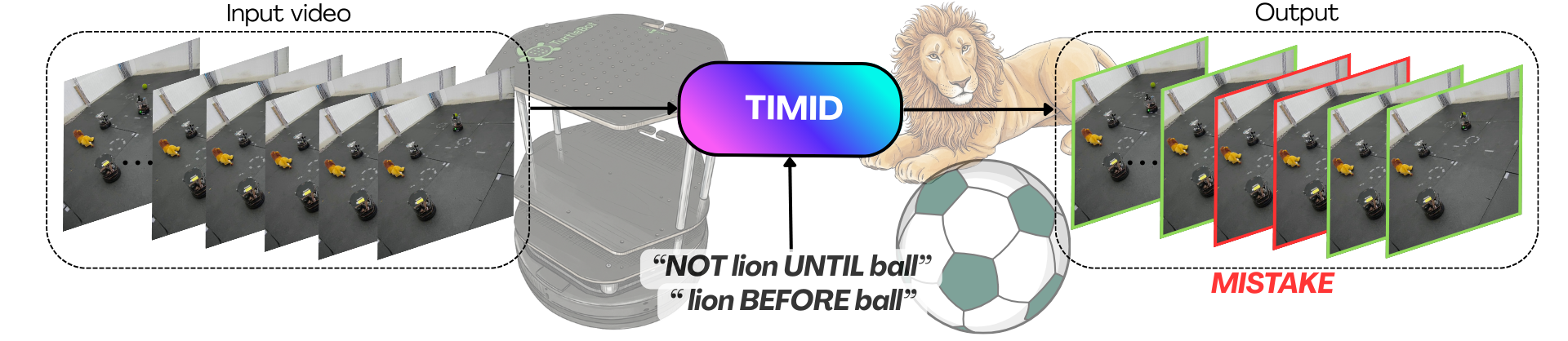
Sometimes a robot does every action of a task correctly but at the wrong time. TIMID detects these mistakes in videos of robot executions by using the temporal constraints between actions.
EventSleep2: Sleep activity recognition on complete night sleep recordings with an event camera
Nerea Gallego*, Carlos Plou*, Miguel Marcos, Pablo Urcola, Luis Montesano, Eduardo Montijano, Ruben Martinez-Cantin, Ana C. Murillo
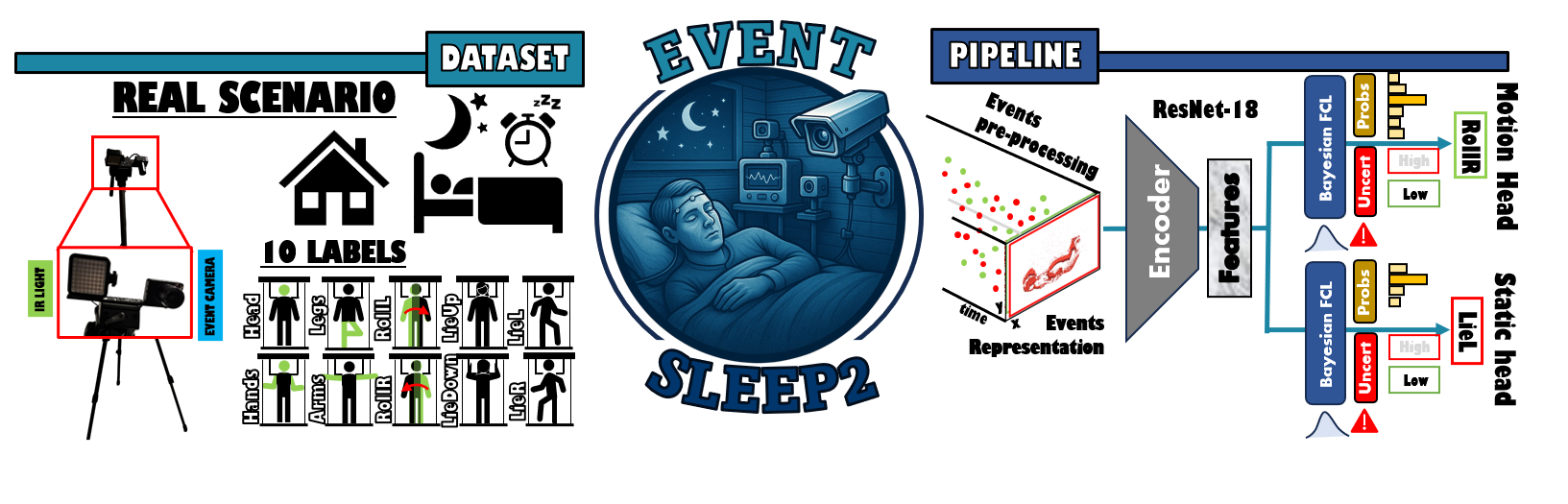
This is the follow-up to EventSleep, now on recordings of complete nights instead of short clips. I handled the acquisition and processing of the full-night recordings. The model also gives an uncertainty estimate for each prediction, using Bayesian deep learning.
Vision-based feedback on correct sensor placement in medical studies
Nerea Gallego, Carlos Plou, Luis Montesano, Ana C. Murillo, Eduardo Montijano
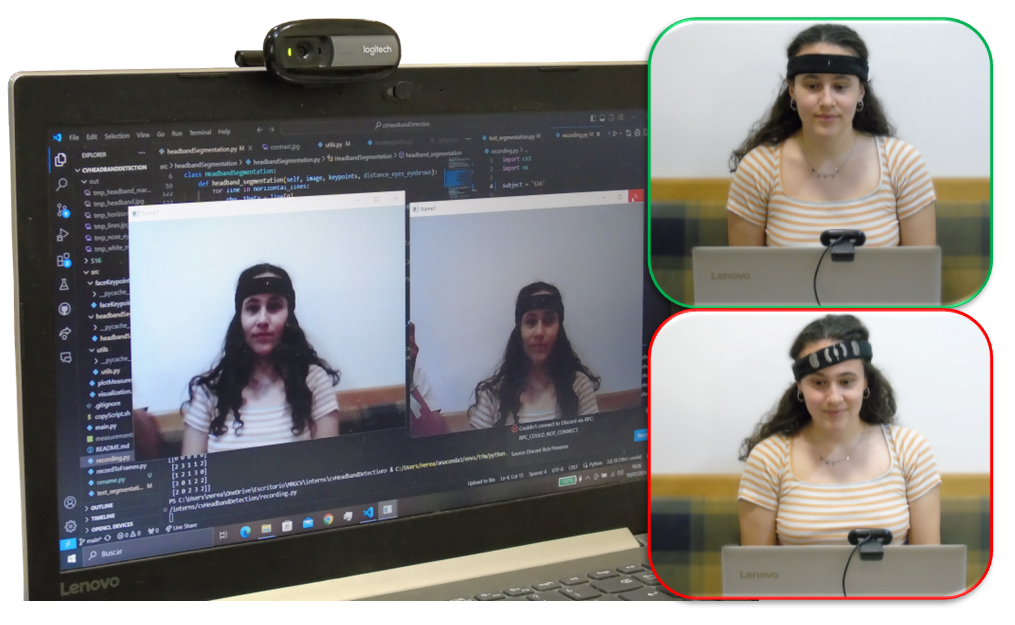
A real-time system that uses a camera to tell the user how to correct the placement of an EEG sensor. I calibrated the sensors, collected data from several subjects and designed the evaluation with users in the loop.
EventSleep: Sleep activity recognition with event cameras
Carlos Plou, Nerea Gallego, Alberto Sabater, Eduardo Montijano, Pablo Urcola, Luis Montesano, Ruben Martinez-Cantin, Ana C. Murillo

We recorded people sleeping with an event camera, which works in low light and is easier to use around patients' privacy than a normal camera. The paper has a new dataset, baselines for recognising sleep activities, and the code. I led the architecture.
Contact
Email is the best way to reach me. I am also on GitHub and LinkedIn.